'%20fill='%23F5FFF7'/%3e%3cellipse%20cx='30.9739'%20cy='32.7492'%20rx='16.5'%20ry='14'%20transform='rotate(46.8241%2030.9739%2032.7492)'%20fill='black'/%3e%3c/svg%3e)
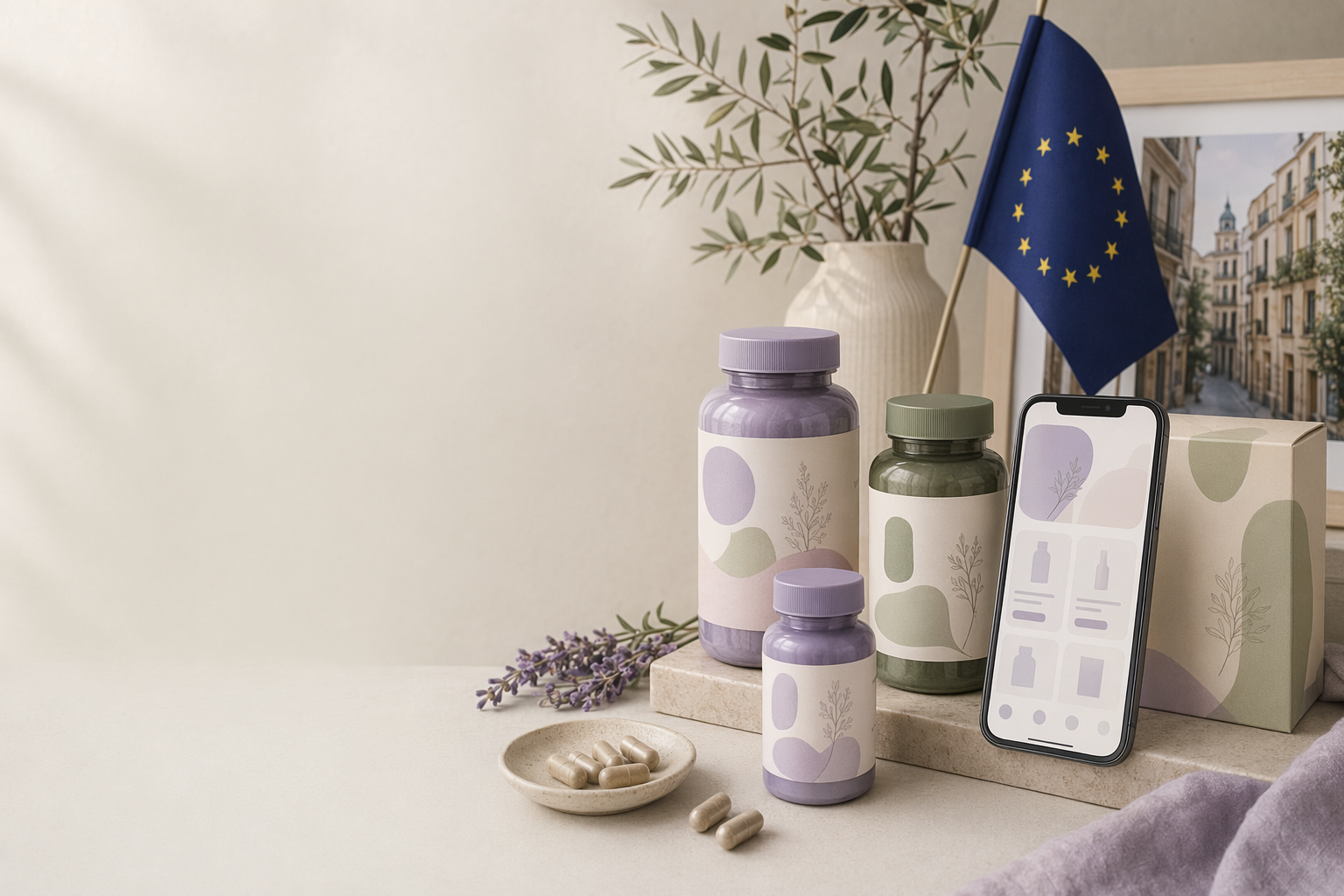
White-label supplements in Europe are how most influencer brands, gym chains, and wellness startups launch without owning a factory. You pick a product, apply your branding, and sell — the manufacturer produces and (sometimes) ships.
Search volume clusters around practical questions:
- White-label supplements EU — who can supply?
- White-label supplements low MOQ — can I start small?
- Private label supplements Europe — same thing, different keyword
- White-label supplement manufacturer Europe — B2B sourcing
This guide covers how the EU white-label market works, what compliance actually means, how MOQs block most creators, and the fastest paths to a branded line — including options that do not require you to become a supplement operator.
New to launching? Read our guide to starting a supplement brand as an influencer first. Comparing bio-link tools? See Can Stan Store sell physical products?.
What white-label supplements mean in practice
A white-label (or private-label) supplement is:
- Manufactured by a certified EU facility from an existing or custom formula
- Labeled with your brand name and design
- Sold to consumers under your pricing and marketing
- Fulfilled by you, a 3PL, or the manufacturer — depending on the deal
You are not inventing creatine. You are curating, branding, and distributing it — the same model behind many influencer supplement lines you see on Instagram.
| Term | What it usually means |
|---|---|
| White label | Catalog product + your label |
| Private label | Often the same; sometimes custom formula |
| Contract manufacturing | Larger runs, more R&D, higher MOQ |
| Print-on-demand supplements | One order, one production run, your label |
Why Europe is a distinct market
EU food supplements are not regulated like the US. The framework differs by member state, but common requirements include:
- Permitted ingredients at allowed doses (EU Register / national rules)
- Label content — ingredients, allergens, warnings, batch traceability
- Responsible food business operator on the label
- Health claims — only authorized EU claims; no free-form medical promises
- VAT on B2C sales — collected and remitted by the seller of record
White-label supplements UK searches still appear post-Brexit; UK has its own rules now. This guide focuses on EU mainland + Ireland shipping — where many creators want a single market with consistent ops.
Getting this wrong is not a marketing problem. It is a stop-selling problem.
How to find a white-label supplement manufacturer in Europe
The traditional B2B path looks like this:
Step 1: Shortlist certified manufacturers
Search for producers with:
- HACCP, GMP, and ISO 22000 (verify certificates, do not trust badges alone)
- Existing catalog SKUs you can rebrand quickly
- EU-wide shipping or depot network
- English (or your language) account support
Queries like "white label supplement manufacturer Europe" and "private label supplements manufacturers Europe" lead to B2B portals, trade shows, and German/Dutch producers — the manufacturing heartland for EU supplements.
Step 2: Request catalog and COGS
Ask for:
- Unit wholesale price per SKU at 500 / 1,000 / 5,000 units
- MOQ per product and per first order
- Label customization cost and lead time
- Sample policy and COA (Certificate of Analysis)
- Which countries they can ship B2C to
Step 3: Label and compliance review
Your label must be reviewed against EU law before print. Budget time and legal review — especially if you write your own claims copy.
Step 4: First production run
Most manufacturers require an initial bulk order. That is where "white label supplements low MOQ" becomes the bottleneck. True low-MOQ EU manufacturers exist but are competitive to find and often limited in SKU range.
Step 5: Fulfillment and support
Unless the manufacturer drop-ships per order, you need a 3PL or your own packing station. Every EU country adds shipping rules, return addresses, and customer support load.
Timeline: 2–6 months from first contact to first sale for a traditional setup. Upfront cost: often €5,000–€25,000 including first stock, labels, and legal.
MOQ: the hidden gatekeeper for creators
| Model | Typical MOQ | Upfront risk | Best for |
|---|---|---|---|
| Traditional white-label manufacturer | 250–2,000 units/SKU | High | Established brands with capital |
| Low-MOQ specialist | 50–100 units (rare) | Medium | Small shops testing one SKU |
| Print-on-demand / no MOQ | 1 unit | Low | Creators, influencers, validation |
| Creator commerce platform | 1 unit | Low | Bio-link traffic, no company setup |
If you are a fitness creator with 15k followers, buying 500 units of three SKUs is €15,000–€40,000 tied up before you know what converts. That is why white label supplements low moq is such a high-intent search — the traditional model was not built for you.
White-label vs doing it yourself
| Approach | Control | Complexity | Speed |
|---|---|---|---|
| Find EU manufacturer + own company | Maximum | Very high | Slow |
| White-label + 3PL + Shopify | High | High | Medium |
| Creator commerce (merchant of record) | Medium (catalog pick) | Low | Fast |
Best white-label supplements lists on Google often rank manufacturers. Useful for operators. Overwhelming for creators who wanted a brand, not a supply chain hobby.
Product categories that work for creator brands
EU catalogs typically include:
- Fitness: creatine, whey protein, pre-workout, electrolytes
- Wellness: magnesium, ashwagandha, multivitamins, melatonin
- Beauty: collagen, hair/skin/nails complexes
- Greens: superfood blends, spirulina
Start with one to three products your content already supports. A creator who posts daily training footage should not launch with seventeen SKUs because the catalog allows it.
Pricing and margin (EU example)
| Creatine example | |
|---|---|
| Wholesale COGS | €8–€12 |
| Suggested retail | €28–€39 |
| Gross profit per unit | €16–€27 |
| Your share (70% on Orla model) | ~€11–€19 |
Shipping is usually customer-paid at checkout — not deducted from your margin. Price for trust and routine, not race-to-the-bottom Amazon logic.
Compliance checklist before you sell
Use this whether you manufacture direct or use a platform:
- Ingredients and doses permitted in target EU countries
- Label reviewed (allergens, warnings, language requirements)
- Authorized claims only — no disease treatment language
- Responsible operator identified on packaging
- VAT process defined for B2C cross-border sales
- Returns and complaint handling in place
- Batch traceability if a quality issue arises
If a partner operates as merchant of record, they handle much of the B2C stack — you still declare personal income tax on your earnings.
Three paths to launch in Europe
Path A: Traditional manufacturer (full operator)
Pros: Maximum control, own the supplier relationship
Cons: MOQ, capital, compliance, fulfillment, 3–6 month launch
Fit: Brands raising capital or with existing retail
Path B: Low-MOQ white-label + Shopify
Pros: More control than Path C, own the store
Cons: You are still the seller of record; ops scale with orders
Fit: Creators comfortable running a small e-commerce business
Path C: Creator commerce platform
Pros: No MOQ, no company to sell B2C, bio-native storefront, EU fulfillment
Cons: Catalog selection vs fully custom formulas
Fit: Influencers who want orla.bio/you live in weeks, not quarters
Orla sits in Path C: EU-compliant catalog, your branding on every label, storefront and checkout for bio traffic, 70% of profit per sale, shipped across the EU in 1–5 days. No minimum orders.
Common mistakes
Choosing manufacturer on price alone. Cheapest COGS with weak certifications creates liability.
Ignoring cross-border VAT. Selling from one EU country to consumers in fifteen others is not "just shipping."
500-unit first order of an unproven SKU. Let demand prove the product; MOQ anxiety kills more creator brands than competition does.
Copying US label claims. EU authorized claims list is stricter. What works on a US influencer's jar may be illegal on yours.
No content plan. White-label product without daily use content converts like a Shopify store with no traffic.
What to do next
- Pick 1–3 catalog products that match your content
- Decide your path — manufacturer, Shopify + white-label, or creator commerce
- Model margin at three retail price points
- Read the launch guide — how to start a supplement brand as an influencer
- Launch — validation beats another month of manufacturer emails
If you want white-label supplements in Europe without MOQ, inventory, or a company setup, join the Orla founding partner waitlist. Pick products, add your brand, put your link in bio — we handle the EU operations stack.